Wednesday, November 16, 2011

Bling by Tyler the Creator?

Here's a quote from Tyler the Creator in a Spin Magazine article on Pitchfork, he's talking about an upcoming release.

"Talking about rape and cutting bodies up, it just doesn't interest me anymore... What interests me is making weird hippie music for people to get high to. With Wolf, I'll brag a little more, talk about money and buying shit. But not like any other rapper, I'll be a smart-ass about it. Now it's just girls throwing themselves at me and shit, but I got a girl back home. People who want the first album again, I can't do that. I was 18, broke as fuck. On my third album, I have money and I'm hanging out with my idols. I can't rap about the same shit."

I thought this was interesting in relation to the Krista Thompson piece and hip hop in general... While I am glad he's not "talking about rape and cutting up bodies" any more, I think it's interesting that he goes straight to talking about money (bling?) and consumerism after gaining a larger audience. Was this pushed on him by a record label or was it an inherent choice? Does capitalism ruin all hip hop artists that gain critical or public success? (Not saying that this will ruin Tyler the Creator, because ethically I cannot support his music as it is right now)
Odd Future, is bling in their future?

Monday, November 14, 2011

Photography and Social Media

Starting off with this interesting infographic from http://mashable.com/2011/11/14/tumblr-infographic/


Manovich:

1. We have moved from media to social media. Businesses, government, nonprofits, community organizations, and individuals all have Twitter, Facebook, and Tumblr accounts. In fact, it is rare to see companies without this on their web page:

from Southwest.com 11/14/11
2. The internet before shifted from most internet users accessing content produced by a small number of professional producers to content created by other nonprofessional producers. However, there was not a large increase in numbers of nonprofessional producers. Only .05-1.5 percent of users contributed their own content. And the long-tail phenomenon:

long-tail phenomenon graph from darwinsbulldog.com
The long-tail phenomenon is basically this: no matter what your content is, the number of people that see your content will never be zero. And, the audience for low popularity websites will exceed the audience for the most popular sites. 

2. To what extent is user-generated content driven by the consumer electronics industry?

Let's think on this question for a minute.

Apple, Microsoft, Sony, Canon, Nikon... is software included in this question? Then we can add Adobe. Electronics as in computers, cameras, video game consols? Or does he really mean digital products? So, there are a small number of professional producers creating templates for us to fill with our own information. We are not creating, just interacting in a way that has already been constructed for us (think Facebook, iChat, Google).

Since last semester, I have been thinking about this a lot in relation to self-portraiture. Self-portraits have always been taken, but now they have become pervasive. This could be because when you set up your new Apple computer, one of the first things it asks you to do is take a self-portrait. When you sign up for gmail, hotmail, iChat, Facebook, Tumblr, Myspace, or any other communicative website, it asks for a self-portrait. Point-and-shoot digital cameras have self-portrait settings. Camera-phones have self-portrait settings. Almost every computer comes with a built in camera and photo booth software. We see and take self-portraits constantly. 

Does anyone remember mirror pictures on Myspace? We see those less now, probably because all of the consumer electronics adapted to the demand for self-portraiture. If this is true, then consumer electronics, software, and social media determine how we take pictures of ourselves. We have visual constructs for self-portraits based on the media we interact with, take the Myspace Mirror Picture for example, you had to have a picture of yourself in order for people to recognize you on the website and if you didn't have one, you were dismissed by other users. There was less self-portrait technology in our electronics at the time, but there were camera phones and digital point-and-shoots. People wanted to see themselves while taking a picture of themselves, easiest solution: Mirror Picture. 

With that logic, the way we see ourselves today is determined by corporations. Apple (Photobooth pictures, self-portrait settings on iPhones), Canon/Sony/Olympus (arms-length self-portraits), and Facebook (cropping yourself out of group pictures for your profile picture), and all other companies that produce products that influence self-portraiture. I did a project in ex-tech appropriating profile pictures from Facebook in visual construction categories, 3 grids of 20 images, printed on mirrors. The categories were profile pictures taken with the Photobooth application on Apple, or similar technology, pictures taken at arms length, and portraits where the user cropped everyone else out of the image except themselves. Everyone takes the same pose, the same vantage point, the same facial expression for their profile pictures. This is all because the technology we interact with is prompting us to construct  images of ourselves this way. 


Photobooth, complete with computer glow


Arms length, we can see the arm

Classic Myspace Mirror Picture

Cutting self out of group photo

Cutting self out of group photo


3. Tactics and Strategies, the government plans the city with roads and buildings and official maps (strategies) and the citizen or individual moves about the city in any way they like (tactics). This relates to the internet in that social media sites create templates for the user to fill with individualized content. How this is turned into profit and capitalized upon: the creators of social media sites sell your information to ad companies so they can target your interests, age group, etc. This feels like a violation of privacy, but you put your information out there to be viewed by everyone and anyone. I think people need to be realistic about the internet and privacy because the two cannot exist together.

4. Social media has made companies and the government more transparent, with blogs by CEO's, business owners, company representatives, and the White House, the initiative to give the public information and listen to the public response has been a major shift in consumerism. We want to feel good about the company we're buying from, and we have the ability to "connect" with them socially (as seen above in the screen shot of Southwest Airline's website).


5. The underground and subcultures that were once "an unmappable forms of subversion" are now marketed and sold to the subcultures that created them (think Etsy and Renegade and Urban Outfitters and Look at this fucking hipster among others).  The transient and ephemeral becomes permanent and viewable. You can put as much or as little out there for the general public to view and at least one person will see it, according to the long-tail phenomenon. And that general public isn't just America, it's the world, as long as the sites aren't blocked by the government of the country you live in. Hundreds of millions of people upload their photographs and status updates and whatnot every day, multiple times a day, and really, they could do this constantly and some do. You can publicize your life on Youtube if you want. You can tell people where you are and what you're doing every moment of every day with Foursquare and Facebook's check-in.


6. While professionals created Youtube, Facebook, Twitter, Tumblr, iPhone, and other media, they also encourage users to create their own applications and programs. Constant change is the only constant in  Web 2.0.

7. Appropriation is the norm, remixing and editing from various sources. This blog is a good example, I've taken photos from other blogs, friends Facebook pages, and I'm quoting and writing about Len Manovich's essay The Practice of Everyday (Media) Life: From Mass Consumption to Mass Cultural Production? and I'm also including my own ideas and opinions too, and potentially others could comment on this blog and so we have thoughts, ideas, photographs from various sources. Hood Internet, Girltalk (which give away their music for free on their websites) and other mash-ups became pervasive after the start of Web 2.0 with the constant sharing of media files through sites like MediaFire. Torrents and pirating are destroying the music industry, but for artists like Frank Ocean, Tyler the Creator and the rest of OFWGKTA, they use Tumblr (http://frankocean.tumblr.com/ http://oddfuture.tumblr.com/) to subvert the system and give their followers albums for free. Radiohead, when they were without a record label, put In Rainbows on their website for users to download for whatever price they wanted to pay, even $0.


Other master appropriators:

After the Dust, 2009, Curtis Mann 

Suns (From Sunsets) from Flickr, 2006-ongoing, Penelope Umbrico
8. Cultural significance has shifted, things carry meaning now that either didn't exist before or did not previously have meaning. Example: Facebook relationship statuses, it's not official until it's "Facebook Official"... one could say that unless you're ready to announce to the world that you're dating, it isn't a real relationship. Unless you're subverting the system and foregoing Facebook altogether.

Share everything, or nothing at all

9. Conversations have the possibility to last forever and not just through one form of communication, but multitudes. One can post a photograph, the photo can be commented on, others can comment on those comments, others can respond with another photograph, or a video, or and audio piece and then years later that same photograph or comment can be again commented on. Manovich goes on to talk about art conversations that were once between schools of thought without any response, just reactions. Those conversations are now simultaneous and constantly back and forth.


10. Do professional artist benefit from the accessibility and ease of distribution and Web 2.0, or because of torrents, pirating, and the like, is professional art irrelevant? Manovich says this question is irrelevant.  Contemporary art has never been so commercially successful, it is open to way more participants than before, it's globalized, it has become a legitimate investment category, and the number of people that can view contemporary art has grown exponentially.

Take Google Art Project for example, if you have access to the internet, you can virtually go to museums, see their layout and design, you can contextualize the room and see what is next to that Max Ernst piece you love, and you can even see some of the paintings in finer detail than what our eyes can see (like with Van Gogh's Starry Night on MoMA's page). Any artist's website allows you to easily see their previous or current work, they can show you what they are doing right at this very moment through a Youtube or Vimeo video (as it is with Brooke Shaden). You can see performance pieces that are across the globe live.


Web 2.0 is certainly democratic, and allows billions of people access to art and each other. But, only if you have access to the internet, and in that way, the internet is not an equalizer, nor is it democratic. Only those with smartphones have the capability to constantly share and change their content on the internet, only those with internet access can look at and converse about art simultaneously. The internet is not free, at least in this country, and even if it were, you would need a computer to access it. Nothing in life is free. But the internet is cheaper and more easily accessible than going to your major art museum.


Interesting things in Jason Evans essay:

1. His notion that "beauty is not about perpetuity" and "In a society that discourages such behavior [referring to putting up one image per day and taking it down after 24 hours], I have owned and shared my happiness," which is ok, but it is a very generalized statement without a lot of support behind it. I really can't stand that he uses "I" in at least half of his sentences. However, this made me think of the Flat Iron building's exhibition last year or the year before in which they had many artists do a long, continuous wall mural, but each artist had one section and they could only see the section that came before theirs. This project took about a month and then they exhibited it for one night and then painted over it. This practice is also like Tibetan sand mandalas. Monks create the mandalas, sometimes for years, and they are intricate and beautiful works. They perform a short ritual with the mandala and at the end, they wipe the sand away.


So, those are examples of art in society that is not about perpetuity.


2. Best sentence of the piece: "If an audience is what you prefer...then the Internet is for you." This, along with Amir Zaki's response to Evans essay, made me think of these questions: Is it more important to be seen at all, or for someone to have the intention to seek out your work? (Zaki goes on about how people that see his work just stumble upon it because his name is the same as a guitar virtuoso, where as if it were in a gallery or museum, people actively seek out artwork). Also, while on the subject of Zaki, he says "it means more to me to have 10 people intentionally spend 20 minutes each seriously engaging with my photographic installations in actual space than it does to know that 100 people happene upon my website." First off, gallery or museum goers, on average, spends less than 30 seconds looking at one artwork. So, I don't know what fantasy world Zaki lives in, but it is EXTREMELY unrealistic to expect even 10 people to look at his work for 20 minutes. Also, Zaki went on and on about it "just isn't time yet" for innovation in art on the web. And how those "artists that choose to participate within [the gallery/museum] structure...are doing so because of a shared desire to be part of a language, a history..." and to that I say: fuck that shit. First off, we should be writing our own history, not waiting for someone else to do it for us. Innovators in art are innovators because they did something different, they created their own toolbox, they didn't use the one that was already there. Now IS the time, there is no better time than now. We're in this weird state where digital, social, and art collide, why not navigate that and use it to the best of it's ability. Or question it and turn it on its head. Let's be innovators, dammit. Fuck the gallery system.

The Donut Shop is an interesting web alternative to the gallery system.

http://thedonutshopprints.tumblr.com/
http://www.the-d-o-n-u-t-shop.com/

When you use any medium, you use it to the best of it's ability and that is what needs to be done with art and the internet. Brooke Shaden seems to be doing fine, and she's using the internet to the best of it's ability: Youtube videos, websites, social media, and yet she is still being shown in galleries. It doesn't have to be either/or, Zaki, it can be both.

I could rant on about his response, but I won't. For now.


Saturday, November 12, 2011

Still reading but...

Here is the video that is mentioned in the Manovich piece.


Wednesday, November 9, 2011

For the love of plank

Rhythm, John McCracken


Lock, James Welling 1976
Contemporary plank:
No title (2x4) Daniel Gordon 2006, from the series One-Day Pictures

Performance plank:


More from the One-Day Picture series by Daniel Gordon (the contemporary plank) because they are interesting and made from paper (like Thomas Demand). They seem to have depth but flatten at the same time (Bustamante?). Sorry to get all Friedian y'all. For more here is his website: www.danielgordonstudio.com


Sunday, November 6, 2011

Control Freaks

Main points from Jeff Wall:

1. Water/Liquid intelligence = nature, natural forms, liquid chemicals in photography, primordial, prehistoric
2. Camera/Optical intelligence= dry, mechanical, scientific, cool

taking those a step further to my own interpretation and thinking about what we've read from Wall's lover, Michael Fried:

3. Water = chance, unexpected, emotion, punctum, physical
4. Camera = objective, representation, indexicality, abstract

5. Wall talks about the move from liquid to digital and that photo without liquid is neither good nor bad just that it is expanding the "famously cool nature" of photography. I think he means that the object/scientific side of photography is proliferated by the digital age and that removing the liquid of the medium takes it out of historical context.
6. Apparently the liquid studies us? He lost me there, maybe because I've never seen Solaris.

Here are the natural forms Wall talks about in Liquid Intelligence:


One thing I've always found interesting with photographers is that is seems like there are a lot of control freaks. Jeff Wall explains liquid in photography and that "it has to be controlled exactly...or the picture is ruined." This sense of control is heightened in the digital age, in which images are becoming more controlled and more perfect. When I see a photo series in which the photographer has built sculptures and sets, I think it takes this controlled nature of photography to the next level, as with Lori Nix and Thomas Demand, because the photographer has created and manipulated every part of the image, nothing has been left to chance. I was also thinking about this in relation to the Ritchin reading last week. The more control we have, the more power we have, the more sense of entitlement we have..s.

Control Room, Lori Nix
Bathroom, Thomas Demand

I can think of 5 projects in my Seminar class that are directly about control. But really, I guess if anyone is using photography they are a control freak.

Walls tangent at the end of the first paragraph got me thinking, are natural forms beautiful to us only in relation to the mechanical and man made? If we had never seen anything man made, would the natural be beautiful? I would venture to say no, because I think beauty is relational. But at the same time, symmetry is inherently pleasing to humans, so perhaps.

Monday, October 31, 2011

The Digital Age

The digital age, according to Fred Ritchin, has killed photography's aura, it's physicality. Photography has expanded.  Comparing the automobile to the digital age in this opening chapter, we can assume Ritchin believes that digital photography has given us more control, more power, more autonomy, more information, and a sense of entitlement.

Digital photography has also "banished the actual experience and flattened it into a small rectangle, preferring its commodification as a picture show. It is not because it makes it more immediately 'real' that we prefer the image, but because it makes it more unreal, an unreality in which we hope to find a transcendent immortality, a higher, less finite, reality."

According to Ritchin, the digital age has created "continuous partial attention," everyone is producing and consuming images all the time. Our world has become photographic: we see and experience the world through a screen. We literally interact with each other through a screen, i.e. Facebook and text messages, continuously being in actual reality and at the same time being in the non-reality of the screen and images. We also are more concerned with experiencing life through a screen, for example, we go to art museums and instead of experiencing the art object, we photograph it. At concerts, no one is experiencing the live music being performed in front of them, instead cell phones and cameras are held up to their faces in order to immortalize and "remember" the event. No one is watching the event, or looking at the object, instead they are looking at a tiny cell phone screen and making sure they are holding the camera steady.

We are constantly ready for our next photo opportunity, the potential image. Nothing just is, everything is now thought of in terms of photographs, everything is staged, nothing is real. At social events, people are more interested in documenting their presence and staging their photographs than actual social interactions, so that their recorded  and staged social interactions can be seen on social media. How constructed and fake and non-real.

Privacy is diminished, with the digital age images last an eternity, there is no decay or sense of time or space, everything is flattened and on the surface. Digital photography can be thought of as surfacism, as Krista Thompson would say.

Finally, Ritchin believes images are replacing reality.

Are they? I think the digital age of photography has put an emphasis on the surface of reality, not the actual visceral experience, but on what can be recorded and immortalized for the world to see. Digital is about appearances, perfection, and consumerism as we can see from the women and men on magazine covers who are an idealized and perfected version of reality. Then there is Facebook, where users can construct their virtual identity, and show not who they are in reality, but who they want to be perceived as, though this idea is not different from pre-digital, it is just expanded and extreme and surfacist.


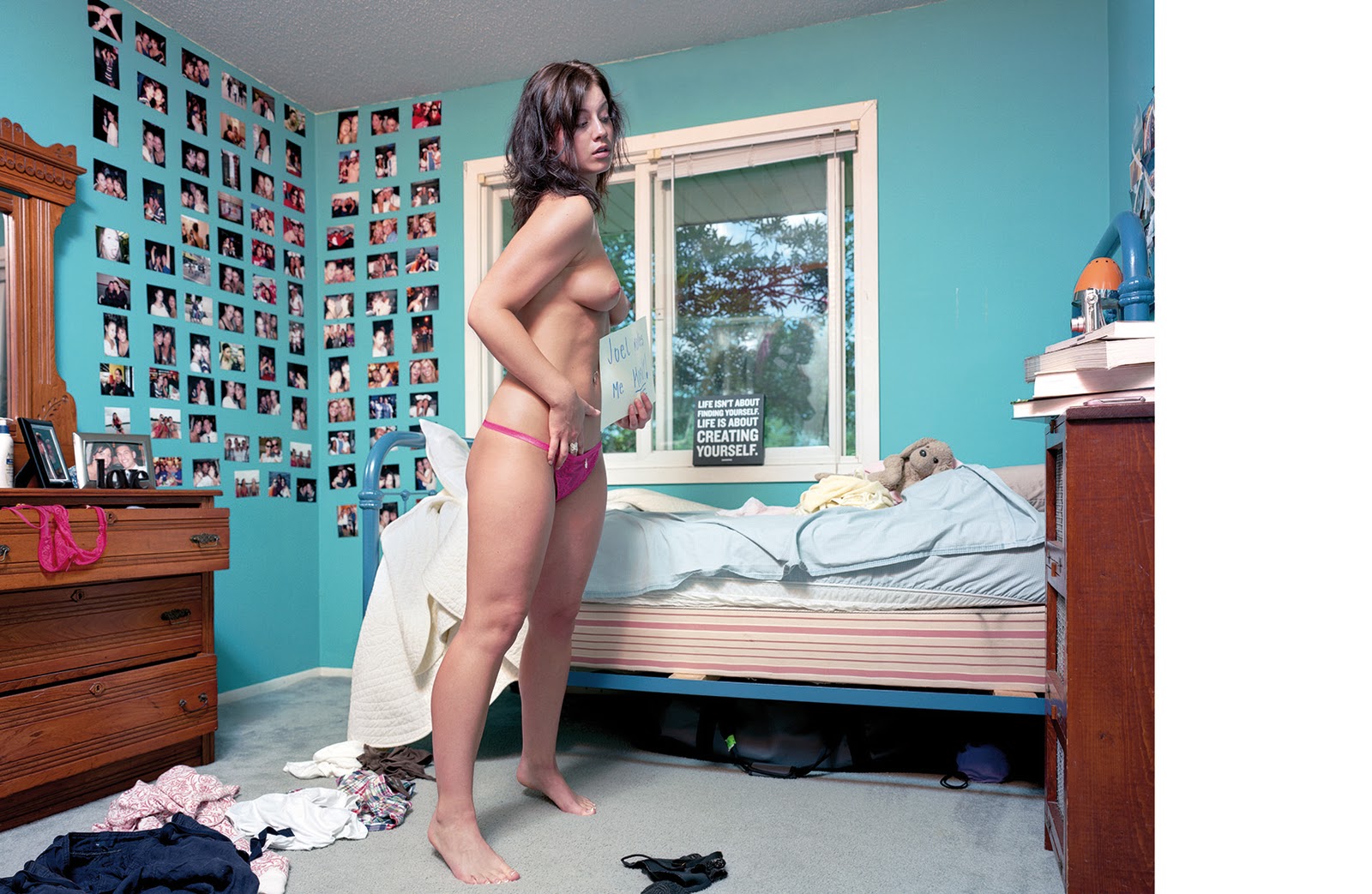
When I first think of this non-reality, the potential image, constant pose, and diminished privacy, I think of Evan Baden's work Technically Intimate.


 This image in particular is an exemplary example because the sign in the window says "Life is not about finding yourself, it's about creating yourself" with the focus on "creating yourself"and the images on the wall are gridded in the style of the Facebook photo album.


Tangent:

This sexuality is performed, created, published, constructed. The images the masses have seen from the porn industry have influenced and constructed what sexuality is, what it looks like, what it can be. These images are representative of how images and media are consumed and produced and influencing each other. Porn, a now digital visual media, expanded along with digital photography and created a billion dollar industry. I think the digital age is the golden age for porn, in the sense that it has never been more prosperous. How interesting.

Not that any of this is a new idea, it has just proliferated through the digital era.


 Jorge Ribalta's "Molecular Documents" starts out comparing digital photography to the onset of globalism and the tearing down of the Berlin Wall. With the death of the physical and chemical analog photography, image makers must reconsider their relationship to their materials. Gone are the days of printing c-prints, there is only one paper left. Processes are dying out, and Ribalta correctly predicts that "new capitalist economies" will provide traditional photography supplies. Polaroid is being revived and Fujiroid came out in response to the end of Polaroid.

Ribalta's central argument is against the notion that photography is dead: "Paradoxically, photography's death is simultaneously its diffuse explosion into culture, its most definitive triumph."Amateurs no longer have to worry about chemicals, processes, editing, printing, viewing. The cost is down, the limits are nonexistent, and everything is autonomous with digital photography, everyone can take pictures now, without having to know anything technical about the medium. Digital photography democratized the medium.

Death of photography, meaning the chemical process, and the birth of the photographic, meaning the new digital age. With the ease of the creating things that never existed, digital photography loses its indexicality. And with photography's history being seeped in a tradition of documenting the real problems of the real world, if photo loses its historical mission of document (realism) as means of social transformation (an Ariella Azoulay idea), it is dead. Literally dead because photography without realism is irrelevant in our culture.

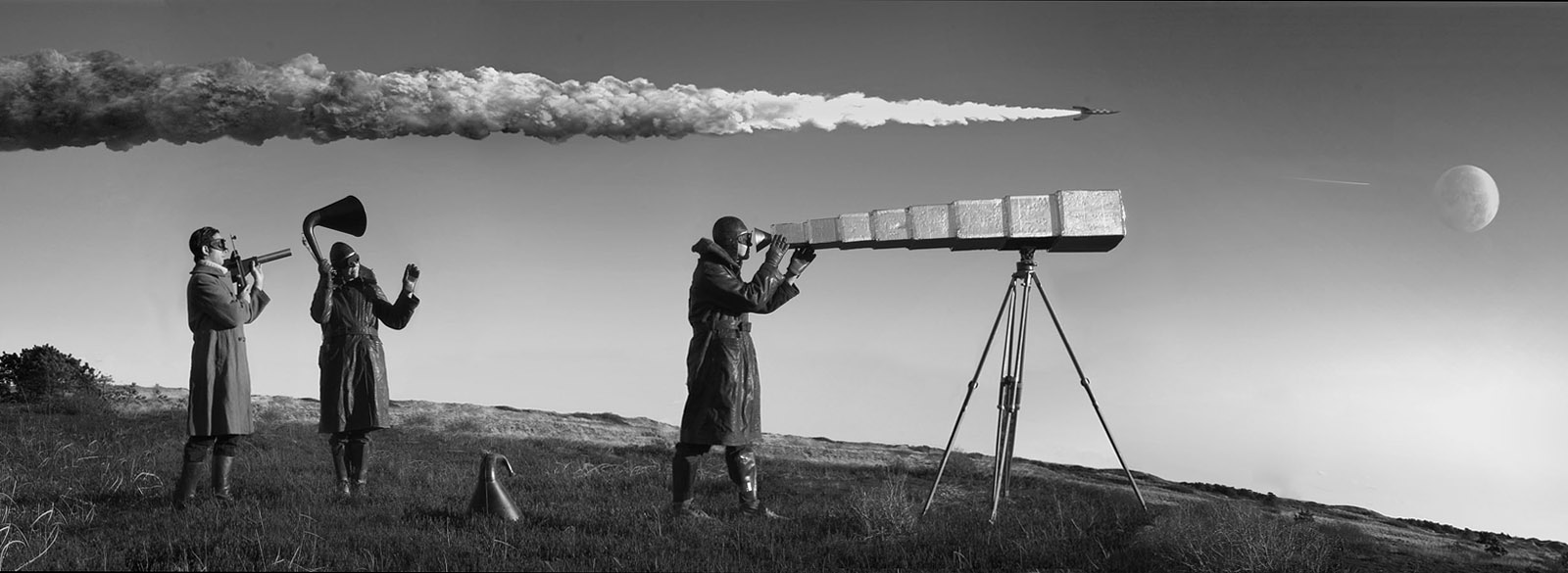
So, how do we maintain social relevance in the age of digital photography? We create a new style of documentary, somewhere between indexical and fake. Staged or, as Fried would say, near documentary. According to Ribalta and Jacques Ranciere, "fiction is the condition for the real to be thought." And in the case of Kahn and Selesnick, Gregory Crewdson, Jeff Wall, Loretta Lux, Matt Siber, Lori Nix, Ben Gest, and Vincent Debanne, this is true.

Ribalta uses Jo Spence as a "strong demonstration that the self-experimentation, self-education, and self learning involved in true artistic play cannot be frozen into art commodities but must constantly resist the reified condition of the art object in the bourgeois public sphere." Or, more simply, Jo Spence questioned what are is and where it should be displayed, and that we should also critique the art institutions. Alternative spaces, like the ones at MDW fair last weekend and the apartment galleries, web galleries, blogs, streets, and all other alt spaces have been an action of the contemporary, digital era. Until now, museums and galleries were the only ways art could be seen and bought. Now there are global art fairs, biennials, and all the spaces I just named. Institutional critiques must continue so we can "transc[ed} art's 'cultural confinement'."We must continue to create our own ways of showing, buying, and creating art.

Ribalta believes we need to reinvent realism, to be in between documentary and fiction, since our world is now in between the real and tangible and the abstract and intangible.
Alt spaces fair for Chicago spaces


Loretta Lux


Ben Gest, imitating painting through multiple images and digital compositing

Gregory Crewdson, creating stories through digital manipulation and compositing

Lori Nix creates her own post apocalyptic worlds through dioramas and digital means

Kelli Connell, Double Life

Jeff Wall, near documentary


Kahn and Selesnick create fictional stories through digital manipulation
Kerry Skarbakka
Kerry Skarbakka, the image that was posted on FailBlog.com and actually believed
Vincent Debanne

Vincent Debanne compsited Metro Map gazers and other environments to create this series


Matt Siber

Matt Siber


Corey Dzenko's "Analog to Digital" claims that digital accelerated and enlarged photographic processes. Though theoretically, digital should lose it's indexicality, viewers still believe digital images and take them at face value.


Because of the photography's physical and chemical connection to reality, it has been used as a visual recorder and historically indexical. From the physical to the digital, the object is abstracted and turned into data. This lack of physical connection to the real world presents a theoretical challenge to the indexicality of photography, especially in since Photoshop makes it easy to create realities and objects and people that do not exist. We, as image consumers, should know all this and mistrust the indexicality and realism of photography, right?


Wrong. Viewers still believe the images they see, whether they are online or in a newspaper. Digital photography has not changed the indexical nature of photography. This is the social function of digital photography, that viewers believe images, always.


Digital has certainly made my life easier as a photographer, but the past year I've missed the physical connection to making art, using my hands. There is a visceral feeling about making things with your hands and the physicality of it that digital can never mimic. Digital is an abstraction, and it feels that way, it feels non-real. I think a lot of photographers are feeling this way and that's why we see people like Elizabeth Ernst painting over her photographs of her sculptures, or Matt Siber starting to build sculptures, or the proliferation of photograms and alternative processes. It's reactionary against digital photography. Also, art schools are beginning to desegregate photography from other arts, becoming more interdisciplinary,  which I think is reactionary against digital photography in the sense that art curriculum gets back to hand made things with a presence and an aura, but at the same time, without digital, photo might have been segregated indefinitely from other forms of art.